Talking With Pets.
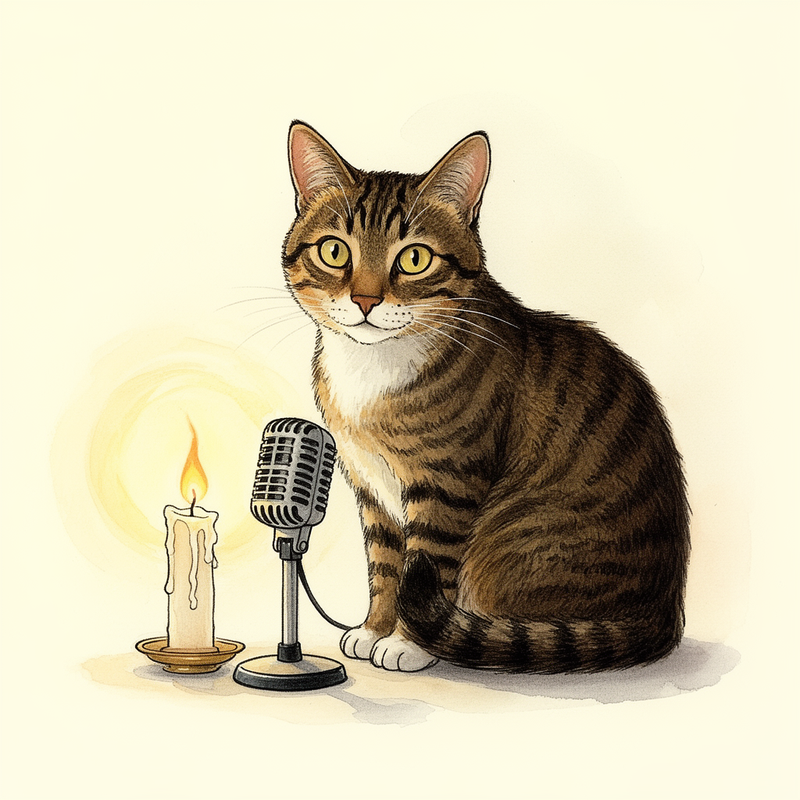
History remembers the famous. Their pets remember the person. A brown tabby cat named Prince MoRee contacts the pets of history's greatest figures and lets them tell what they really saw. True, surprising, and funnier than history has any right to be. Great for curious kids and the grown-ups listening with them.
What Talking With Pets is
A pet is the one who watches a person closely and loves them anyway. History keeps the famous: the speeches, the inventions, the marble. Their pets kept the person. The gap between the official record and what the pet saw is where the truest, and the funniest, version of a life lives.
Every episode, Prince MoRee contacts the ghost of a famous figure's pet, and the pet tells what they really saw. A goat who lived in Lincoln's White House. A fox terrier who watched Darwin send his son to play the bassoon at earthworms for twenty years. A husky who ran the part of the 1925 serum race that everyone forgets. The history is real and carefully sourced, delivered warm and funny so a child actually remembers it.
The cast is five real pets from one real family: Chaco, Roxie, Moose, Prince MoRee, and Armando. They are also the cast of the Talking With Pets children's books. Talking With Pets is a Talking With Pets production. You talk with pets in the books; you listen with pets in the show.
How we keep it true
This is comedy, and it is honest, and those are the same thing here: a specific true fact is funnier than an invented one. Every episode sorts what it tells you into three tiers, and says so out loud, so a child learns to ask the same question of everything they read.
The real dates, names, species, and events, drawn from primary sources and named biographies. This part is checked before the script locks.
The grounded inferences: the feel of a room, a daily habit, the emotion of a documented moment. Reasonable, never contradicting the record.
The playful, clearly impossible parts the pet dreams up. Always recognizable as invention, never something a child could repeat on a test as fact.
Each episode page shows its sources in full. That is the part that earns a teacher's trust, and it doubles as a media-literacy lesson hidden inside a comedy. Educators can find standards-aligned guides on the educators page.
The episodes
Season 1 is fourteen episodes, written for ages 6 to 10 and made for the whole car. Season 2 is a full bank of nineteen more episodes, already scripted and reviewed: seven more all-ages episodes plus a full twelve-episode Older Kids tier for ages 9 to 12, told up a band, never grown-up. Every episode below has a full page with its story, sources, and honesty tiers; transcripts and audio players arrive as each episode goes live.
Season 1 · ages 6 to 10
The Dog Who Watched Darwin Watch Worms
Darwin figured out how all of life works, then spent his later years finding out whether earthworms could hear, by having his son play the bassoon at them. His dog saw the whole thing.
The Hound Who Stole the General's Dinner
Washington bred his own hounds with names like Sweet Lips and Drunkard. One of them stole a whole ham off the table set for guests, and Washington thought it was funny. The dogs he actually loved.
The Parrot Who Kept Calling a Famous Dog
African Grey parrots learn what a name does. A trained dog comes when its name is called. One parrot, one facility, and the most reliable bit in history, still running. The purest comedy in the catalog.
The Sled Dog Who Did the Hard Part and Got None of the Credit
Everyone knows Balto, who ran the last 55 miles into Nome. Togo ran 264, across the breaking sea ice nobody else would risk. The true story of the race to carry medicine across Alaska.
The Horses Outside the Constitutional Convention
Fifty-five delegates spent four months inside Independence Hall writing the Constitution. Their horses waited outside the whole time. Three of them compare notes: Washington's steadiness, Madison's ink, and a republic, if you can keep it.
The Squirrel Benjamin Franklin Wrote an Epitaph For
Franklin, with the whole heavy world on his desk, stopped for an afternoon to write a formal epitaph for a child's dead squirrel he had never met. The history books keep the lightning. We get to keep Mungo.
The Badger Who Bit His Way Through the White House
A Kansas girl handed the President a badger in 1903, and Josiah moved into a White House that already had a bear cub and a one-legged rooster. His verdict on Roosevelt: the most alive person I ever bit. There's a difference.
The Goat Who Kept Lincoln Company at Two in the Morning
Tad Lincoln's goats ate the flower beds and drove a chair sled through a state reception. And through the hardest middle of the war, the president came out to the lawn at night and sat down next to a goat.
The Horse Who Actually Finished Paul Revere's Ride
You know Paul Revere's ride. You've probably never heard of the borrowed mare who did all of the running, got confiscated by the British patrol that let Revere walk home, and never made it into the poem.
The Dog Who May Have Burned Down a Genius's Notebook
There is a story that Newton's little dog knocked over a candle and burned years of work. Even Diamond is not sure how much of it is true. A funny, honest episode about how we decide what really happened.
The Dog Alexander Graham Bell Taught to Talk, Sort Of
Bell shaped his terrier's growls until a room heard "How are you Grandmama," on the way to inventing the telephone. Trouvé tells the story of a teacher of the deaf who was never sure which one he was.
The Pony Who Is Sure He Made Seabiscuit Fast
Seabiscuit was losing before Pumpkin arrived and winning after. The trainer, the jockey, and the owner also arrived around then, but the timeline speaks for itself. He is listed fourth in that sentence and he is still on the list.
The Cat Who Watched Mark Twain Go Broke and Pay Everyone Back Anyway
Twain named his cats Sour Mash, Pestilence, Famine, and Beelzebub. Sour Mash watched him lose a fortune on a machine that never worked, then choose to repay every creditor by lecturing his way around the world.
The Scottie Who Outranked the Generals
Fala went where presidents go: aboard ship for the Atlantic Charter, into a national radio joke that became a famous speech, and finally into the funeral procession and a bronze statue beside his person.
Season 2 · ages 6 to 10
The Dog Who Walked All the Way to the Pacific and Back
Lewis bought a big Newfoundland for twenty dollars, and Seaman became the only animal to complete the whole Lewis and Clark expedition. A true adventure, including the honest fact that we never learned how his story ended.
The Bird Who Took Food From Jefferson's Lips
Jefferson kept a mockingbird that flew free around his study, perched on his shoulder, and took food from his lips. A small, true, tender story about a famous man and the bird who kept him company.
The Bear Who Invented the Teddy Bear
Roosevelt refused to shoot a bear that had been tied to a tree. A cartoon ran two days later, a toymaker made a stuffed bear, and the teddy bear was born. The bear tells it herself.
The Puppy the CIA Investigated
Soviet Premier Khrushchev gave Caroline Kennedy a puppy whose mother had flown to space, and the CIA checked her for listening devices before she moved into the White House. A true Cold War story with a very good dog at the center.
What the Animals Saw at Gettysburg
Four animals lived through the same three days in July 1863 from four different places. None of their descriptions match. All of them are true.
The Cheese Samuel Pepys Buried
With London burning a few streets away, the most fastidious diarist of the seventeenth century buried his cheese and his wine in the garden. Four animal witnesses tell the fire from four positions.
What the Expedition Animals Actually Saw
A companion piece to Seaman's own episode: a panel of animals who were there, telling the same expedition from angles Seaman's single voice does not cover.
Season 2 · Older Kids tier, ages 9 to 12
For families ready to go a little deeper: same show, same honesty, told up a band and never grown-up.
The Dog Who Was Emily Dickinson's Mute Confederate
Carlo the Newfoundland lived with Dickinson for sixteen years and appears in more than thirty of her letters. He was how a poet who rarely left her house went outside.
The Cat Who Kept Poe's Household Warm
Poe invented the detective story. His cat Cattarina slept on Virginia Poe's chest to keep her warm during her illness. The show's quietest, most careful episode.
The Monkey Who Was Painted Into Kahlo's Portraits
Fifty-five of Frida Kahlo's 143 works are self-portraits. Her spider monkey Fulang-Chang appears in several of them and explains how a constraint became a method.
The Ocelot Who Walked the Champs-Elysees
Chiquita explains the three lives of Josephine Baker that were always one life: the performer, the Resistance courier, and the activist who never performed for a segregated audience.
The Fawn Who Went Grocery Shopping With Audrey Hepburn
Hepburn hand-raised a fawn named Ip for a film role and kept her afterward. Ip tells both chapters of Hepburn's life, the actress and the humanitarian, and finds out they were never two chapters at all.
The Cat Who Watched Churchill Run the War From His Bathtub
A black cat named Nelson sat on the floor through the Blitz, the underground war rooms, and the speeches rehearsed for forty years.
The Ocelot Who Went to Restaurants With Dali
Babou sailed on the SS France and dined out with Dali, who once explained him away as an ordinary house cat in an op art design. The shy man behind the mustache, explained by his ocelot.
The Dog Marilyn Monroe Named After the Mob
Frank Sinatra's associates delivered the dog, so Monroe named him Maf, short for Mafia, as a joke. Maf explains the woman who fought her own studio to be taken seriously.
The Cat Freddie Mercury Called From Every City
Mercury had staff hold the phone to his cat Delilah from every tour stop. Delilah explains Bohemian Rhapsody, Live Aid, and the quiet kitchen mornings that were just as real as the stage.
The Dog Painted Into Picasso's Velazquez
In 1957, Picasso painted his dachshund Lump into fifteen variations of Velazquez's Las Meninas. Lump explains the shared breakfast plate and an artist who saw four things at once.
The Cat Who Watched Einstein Rewrite Physics
Einstein was certain general relativity was correct four years before the 1919 eclipse proved it. His cat Chico explains a mind that never stopped asking one question.
The Pigeon Nikola Tesla Loved Most
Tesla fed the pigeons of Bryant Park every day for decades and built a splint for one pigeon's broken wing. She explains the war of currents and the wireless future he imagined early.
What is Talking With Pets?
A kids history podcast where a brown tabby cat named Prince MoRee contacts the ghost of a famous figure's pet, and the pet tells the true story of the person it watched. It is the audio sibling of the Talking With Pets children's books. You talk with pets in the books; you listen with pets in the show. True, surprising, and funnier than history has any right to be.
Who is the show for?
Kids are the primary listeners, and parents are glad to listen along. It is made for curious children and the grown-ups in the car with them. Season 1 is fourteen episodes for the core audience, ages 6 to 10. A full Season 2 bank of nineteen more episodes is already scripted and reviewed, including an Older Kids tier for ages 9 to 12 that takes on richer subjects. It is also built for homeschool and classroom use.
Is the history accurate?
Yes. Every episode is built on verified facts, and every dramatized moment is sourced. The dates, names, species, and events are real. The pet's voice is invented, and the show is honest about which is which through a three-tier format: What's Documented, What We Filled In, and What We Imagined. Each episode page shows its sources.
Who are the five pets?
Chaco, Roxie, Moose, Prince MoRee, and Armando. They are real animals from one real family, and they are the cast of both the Talking With Pets podcast and the Talking With Pets children's books. Prince MoRee, the brown tabby, is the medium who runs the show.
When does it launch?
Season 1, fourteen episodes, is in production for a 2026 soft launch, with a full Season 2 bank of nineteen more episodes already scripted and reviewed, ready to follow on a weekly cadence. Join the founding list and we will write to you when the first episodes go live.
Talking With Pets · the true stories only the animals saw.
Chaco, Roxie, Moose, Prince MoRee, and Armando are getting the pilot ready. Join the founding list and we will write to you when the first episodes go live. Listen with someone you like.